

Please update your browser.

It looks like you are using an old version of the Microsoft Edge browser. To get the best experience with the Busch website, please update your browser.

pharma_biotech_stage_final

Reliable Vacuum Solutions for the Pharmaceutical Industry

From ingredient production to packaging, vacuum is essential to making medicines safe and reliable. Our solutions provide stable performance and trusted support, helping manufacturers protect patients while keeping processes efficient and sustainable.

The role of vacuum in pharmaceutical manufacturing

Vacuum in pharma is more than a utility - it safeguards processes and ensures compliance. Across the value chain, it protects sensitive ingredients,
From lab to production and packaging – one integrated partner for pharmaceutical vacuum and leak detection.
secures product quality, and enables sterile packaging.

Busch adds value with solutions designed for stability under changing loads, resistance to aggressive solvents, and scalability from lab to production.

Built in line with Good Manufacturing Practice (GMP) principles - with cleanable surfaces, oil-free options, and full documentation - they help manufacturers ensure reliable, efficient, and sustainable operation.

The graphic below maps the role of vacuum and leak detection technologies at each stage of pharmaceutical manufacturing, from development and production to final package verification.

Vacuum and leak detection across the pharmaceutical manufacturing workflow

Vacuum applications in pharmaceutical and biotech industry

Busch solutions accompany the entire pharmaceutical value chain across four key areas:

Vacuum for pharmaceutical production

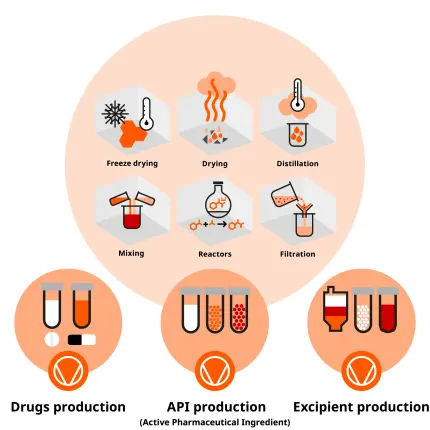
In active pharmaceutical ingredient (API), excipient, and drug production, vacuum supports essential process steps such as drying, distillation, solvent recovery, and filtration. Stable vacuum conditions protect heat-sensitive substances, secure yields, and prevent contamination, ensuring reproducible processing.
pharma_production_final

Drying and degassing

Drying, filtration, degassing, and solvent recovery are applications that typically require pressures above 1 hPa (mbar) to be carried out effectively without oxidation.

Matching products


Freeze drying and distillation

At pressures below 1 hPa (mbar), processes such as freeze drying and vacuum distillation are used to protect heat-sensitive products and achieve long-term stability.

Matching products

Pharmaceutical packaging and material handling

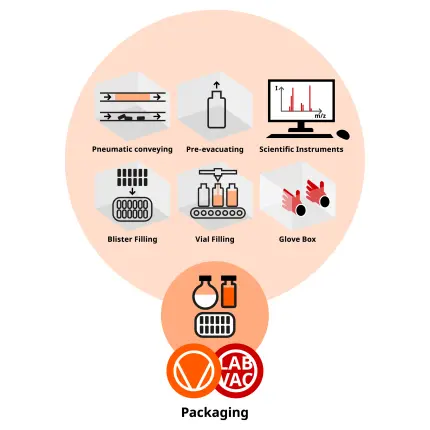
Reliable vacuum supports sterile conveying, precise filling, and airtight sealing, safeguarding packaging integrity while enabling high-speed operation. It is used across multiple packaging and material handling steps in pharmaceutical production, including the following key applications:
pharma_1000x1000_packaging

Pharmaceutical sterile packaging

(Blister, vial, and syringe filling with pre-evacuation and sealing)
Stable, clean vacuum ensures reproducible dosing, airtight closures, and contaminant-free handling in aseptic environments. This safeguards sterility and product stability while meeting regulatory expectations.

Matching products


Pneumatic conveying

Vacuum gently moves powders and granulates, preserving the integrity of active substances while minimizing cross-contamination.

Matching products


Pick and place

On-demand vacuum enables precise, high-speed positioning of components and packaging materials. Quick-release mechanisms and precise control of vacuum levels ensure fast cycle times while reducing energy use.

Matching products

Quality control and laboratory vacuum

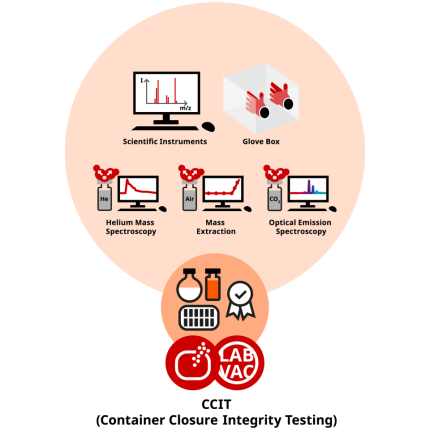
As part of the Busch Group, Pfeiffer Vacuum+Fab Solutions provides specialized technologies for laboratory applications and CCIT. These solutions are essential to safeguard product sterility, ensure regulatory compliance, and deliver reproducible results across pharmaceutical and biotech workflows.
pharma_1000x1000_ccit

Laboratory applications

Reliable vacuum is critical for instruments such as mass spectrometers, glove boxes, and freeze dryers. Laboratory vacuum pumps from Pfeiffer operate quietly, with low vibration, and require minimal maintenance. They enable consistent results in R&D, quality control, and pilot-scale production.

Matching products


Container Closure Integrity Testing (CCIT)

Deterministic methods such as helium mass spectrometry, Optical Emission Spectroscopy, and mass extraction detect even the smallest leaks that could compromise patient safety. These methods meet the expectations of EU GMP Annex 1 and USP <1207>.

Matching products

Your one-stop partner for pharma

The Busch Group

By combining production and packaging expertise from Busch with laboratory and CCIT technologies from Pfeiffer Vacuum+Fab Solutions, the Busch Group provides end-to-end vacuum and integrity assurance across the pharmaceutical value chain.

Pharma and biotech solutions by Pfeiffer

About the Busch Group
cross_promo_pharmabiotechpfeiffer_busch

Service and leak detection

Reliable operation is as critical as production performance. Busch operates one of the largest global service networks supporting pharmaceutical manufacturers in every major market.

Extended warranties and readily available spare parts further secure long-term reliability. By combining global reach with local expertise, Busch enables pharmaceutical manufacturers to minimize risk, safeguard compliance, and extend the lifetime of their vacuum systems.
pharma_service_and_leakdetection
  • Preventive maintenance and planned exchanges keep vacuum systems running smoothly, reducing unplanned downtime.
  • Digital monitoring with OO identifies wear and process deviations early, lowering energy consumption and preventing failures before they disrupt validated processes.
  • ATEX compliance checks verify safe operation in explosive environments, helping production sites meet regulatory and safety requirements without costly interruptions.
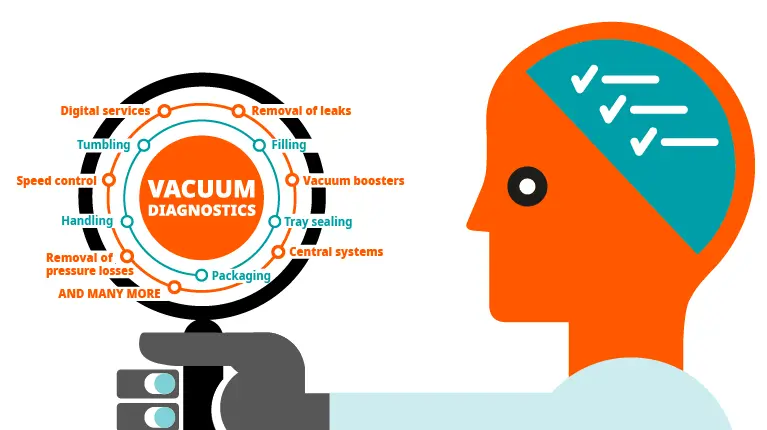
  • Vacuum Diagnostics provides on-site analysis of energy use, performance, and system condition. Customers gain fact-based recommendations to optimize efficiency and plan investments with confidence.
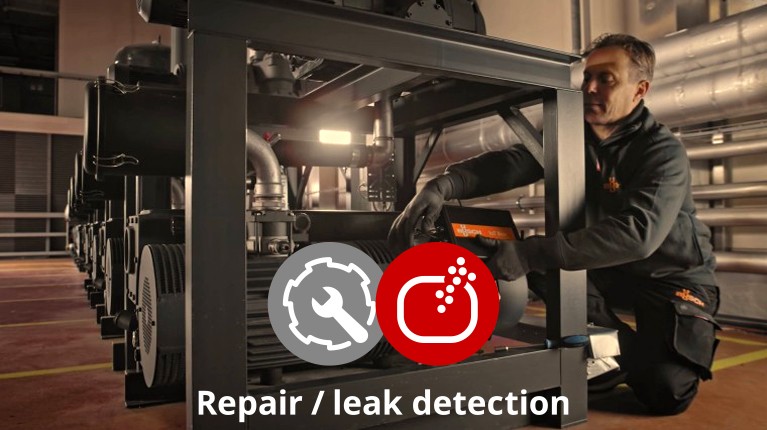
  • Leak detection services, performed by Busch service experts or integrated into customer workflows, deliver the sensitivity required to protect sterile processes from micro-leaks that could compromise product safety.

Matching products

Our solutions for pharma and biotech manufacturers

Depending on the process step there are different demands on vacuum technology. The Busch Group offers application-specific solutions tailored to production, packaging, and quality-critical processes. Suitable technologies can be selected for each process step using the product finder below.
  • cobra_nx_0450_a

    Screw vacuum pumps

    For clean, contaminant-free handling of APIs and solvents.

    Screw pumps
  • r5_rd_0360_a

    Rotary vane vacuum pumps

    For versatile, cost-efficient operation across multiple production steps.

    Rotary vane pumps
  • dolphin_lx_0260_c

    Liquid ring vacuum pumps

    For processes with high vapor loads or aggressive solvents.

    Liquid ring pumps
  • mink_mv_0312_b_1

    Claw vacuum pumps

    Oil-free, energy-efficient pumps ideal for continuous and clean operation.

    Claw pumps
  • panda_puma_1

    Vacuum boosters

    Where lower pressure or higher throughput are required.

    Vacuum boosters
  • rendering_tyr_wt_0730_ap_plus_72dpi_rgb_767x430px

    Rotary lobe vacuum pumps

    The quiet and robust vacuum and overpressure generators.

    Rotary lobe pumps
  • vactest_dcc_400_digital_transmitter

    Vacuum gauges

    Ensure smooth processes and highest product quality by controlling vacuum levels.

    VACTEST
  • 13628_asm_340

    Leak detectors

    Save costs and ensure the stability of your process through leak tightness.

    Leak detectors

Vacuum solutions for pharmaceutical production

Busch provides a complete technology range tailored to these requirements:


Systems can be specified with ATEX-compliant safety and corrosion-resistant materials to ensure safe handling of explosive or aggressive media. Intelligent vacuum control reduces energy consumption while stabilizing process performance, supporting both GMP-aligned operation and sustainable production.

Vacuum solutions for pharmaceutical packaging and material handling

With a portfolio spanning rotary vane, dry claw and screw vacuum pumps as well as compact vacuum pump units, Busch ensures packaging processes remain clean, reliable, and audit-ready.

  • Dry vacuum systems for sterile areas,
  • Centralized vacuum systems to supply multiple packaging lines with consistent performance,
  • Intelligent vacuum regulation that adapts to demand, reducing energy consumption and unplanned downtime.

Tailored solutions for pharmaceutical applications

Every pharmaceutical process has its own requirements. That is why Busch goes beyond predefined vacuum pumps to deliver custom-engineered vacuum systems designed around customer specifications. Solutions range from distillation units with condensers to centralized vacuum systems and CCIT chambers that integrate seamlessly into complex production environments.
solution_optimized_process
Our strength lies in project management and engineer-to-order execution. We work closely with customer specifications, follow approval processes, and deliver systems with full documentation packages. This includes installation, operating and service manuals as well as manufacturing data records. Where required, solutions can be delivered with IQ/OQ documentation support and in compliance with local safety and quality standards such as CE, ATEX, or PED.

For demanding applications, vacuum systems from Busch can be built with special materials (such as stainless steel, Hastelloy, or PTFE-lined piping) and enhanced with protective coatings and accessories (e.g., pump purging) to ensure safe handling of aggressive chemicals and long-term reliability.

Lower emissions, higher efficiency

The APOVAC vacuum system

Pharmaceutical production must meet strict environmental and safety regulations. Solvent emissions, high energy demand, and regulatory reporting are recurring challenges. The APOVAC vacuum system addresses these directly by:

  • Condensing vapors inside the system to minimize solvent release and reduce emissions of volatile organic compounds (VOC).
  • Lowering exhaust temperatures, improving process safety and cutting thermal load on exhaust treatment.
  • Reducing energy consumption through efficient vapor management and optimized vacuum generation.

With these features, APOVAC not only supports environmentally compliant operations but also helps manufacturers lower operating costs and demonstrate measurable sustainability gains in line with regulatory expectations.
rendering_apovac_72dpi_rgb_isolated

FAQ

Why is vacuum technology essential in pharmaceutical and biotech manufacturing?

Many critical processes in life sciences cannot be carried out reliably at atmospheric pressure. Vacuum lowers the pressure, which reduces boiling points for gentle drying of heat-sensitive APIs and biologics, supports solvent recovery, and prevents oxidation or contamination. Vacuum also ensures stable conditions for sterile filtration, freeze drying, pharmaceutical reactors, and packaging integrity testing. In all these various applications, vacuum helps improve product quality, extend shelf life, and ensure safer medicines for patients.

What types of vacuum pumps are suitable for pharmaceutical and chemical production processes?

Vacuum pumps in pharma must withstand demanding process conditions. The choice of technology depends on factors such as process temperature, solvent load, energy efficiency, waste treatment, investment cost, and long-term reliability.

There is no universal “best” vacuum pump. The selection always depends on the specific application. Among the factors to consider is the operating principle - whether the system runs dry or uses an operating fluid:

  • Dry vacuum pumps (e.g., screw vacuum pumps, claw vacuum pumps, or combinations with vacuum boosters) operate without oil in the compression chamber. They minimize the risk of contamination, ensure clean processes, and require low maintenance. Differences within this category are significant: screw and claw vacuum pumps vary in achievable ultimate pressures, while booster stages can be added to all vacuum pumps to gain lower pressures.
  • Vacuum pumps with operating fluid, also sometimes referred to as wet vacuum pumps (e.g., rotary vane or liquid ring vacuum pumps), use operating fluids such as oil, water, or special solvents. They are robust, cost-effective, and highly tolerant of vapors and particles. Even within rotary vane vacuum pumps, designs differ in terms of durability and cost of ownership, for example, systems with defined oil reservoirs (like the R5) versus once-through lubricant systems (like the HUCKEPACK). The latter handles higher vapor loads but has higher operating costs.

Busch often combines technologies and adds components like condensers to achieve the right mix of performance, reliability, and efficiency. This tailored approach ensures optimal compliance, stable operation, and long-term cost control for pharmaceutical companies.

How can I get a customized vacuum system for my pharmaceutical process?

Busch develops tailor-made vacuum systems using a structured six-step approach. It begins with consultation and analysis to understand your process, followed by detailed design and quoting. Once approved, the system is built with the right components, such as condensers, separators, or control units, and installed with training for your team.

Our global service experts then ensure long-term reliability, compliance, and customer satisfaction. Systems can be built with special materials and are supplied with full documentation to meet regulatory standards.

Ready to design your system?
Get in touch with Busch to find efficient solutions tailored to your pharmaceutical process.

Contact us

How do vacuum systems from Busch support pharmaceutical production in alignment with GMP compliance?

Vacuum pumps do not fall under GMP regulation, since they remove air/vapor rather than introducing material into the product. However, Busch vacuum systems are engineered to support GMP-friendly operations by preventing backstreaming, installing suitable filters/traps, and delivering full documentation. These features assist in maintaining clean, controlled environments that support product quality and facilitate regulatory compliance.

How can I verify that my vacuum system for pharmaceutical products is still efficient and up to date?

Vacuum Diagnostics from Busch gives you a detailed on-site analysis of your existing vacuum supply. Our experts measure system condition, energy use, and process requirements, then provide a clear report with concrete recommendations. This helps you uncover hidden inefficiencies, extend equipment lifetime, and ensure that your vacuum system continues to support the stable conditions required for pharmaceutical production. The value can be in lower operating costs, improved reliability, and full transparency about whether the current setup is still the right fit.

Vacuum Diagnostics not only highlights optimization potential but also guides you toward solutions that improve process stability and product quality. You gain a fact-based basis for investment decisions and confidence that your system will continue to meet production demands.

How does vacuum technology improve pharmaceutical packaging?

Vacuum ensures sterile filling, airtight sealing, and safe handling in blister packs, vials, and syringes. It prevents contamination, protects product stability, and supports regulatory compliance. Busch brings unique expertise here: as the global market leader in food packaging and other industries, we can deliver proven reliability, high efficiency, and consistent integrity at an industrial scale.

What is Container Closure Integrity Testing (CCIT) and why is it important in pharma?

CCIT verifies that primary packaging, such as vials, syringes, ampules, and blister packaging, remains airtight and sterile. Deterministic methods, such as helium leak detection, vacuum decay, or mass extraction, detect even the smallest leaks that could compromise product quality or patient safety.

For pharmaceutical manufacturers, CCIT is a key element of pharmaceutical compliance. The EU GMP Annex 1 explicitly requires the use of deterministic test methods to demonstrate container closure integrity. Pfeiffer provides these proven technologies, ensuring that packaging integrity is safeguarded and regulatory expectations are met.

Find out more

What does EU GMP Annex 1 require for CCIT?

Annex 1 of the EU GMP sets clear expectations for container closure integrity in sterile manufacturing. Fusion-sealed containers (such as ampules or BFS products) must undergo 100 % integrity testing. For other packaging, validated and scientifically justified CCIT methods are required, supported by a statistically sound sampling plan. Visual inspection alone, like with the blue dye test, is not acceptable. The guideline emphasizes deterministic methods like helium leak detection or vacuum decay, as they deliver objective, reproducible results. CCIT must be applied across the product life cycle to safeguard sterility and patient safety.

Why is freeze drying important in pharmaceuticals, and how does Busch support it?

The freeze drying process (lyophilization) protects heat-sensitive pharmaceuticals such as vaccines, antibiotics, and biologics by removing water under vacuum. It relies on the primary drying phase (ice removal through the sublimation process) and the secondary drying phase (elimination of bound moisture) to achieve long-term stability.

Busch delivers value by providing vacuum systems that ensure stable conditions at the right temperature and pressure, oil-free options to avoid contamination, and energy-efficient booster combinations. For advanced assurance, integrated residual gas analysis (RGA) can detect silicone oil leaks from cooling lines, preventing contamination of pharmaceutical products and securing batch integrity.

Read more

What vacuum pumps are suitable for drug development?

In drug development and pharmaceutical research, laboratory processes rely on stable vacuum conditions for applications such as mass spectrometry, glove boxes, freeze drying, and quality control testing. Reliable vacuum is essential to ensure reproducible results, safeguard sterility, and support compliance throughout the research pipeline.

For these needs, Busch and Pfeiffer provide a wide range of laboratory vacuum pumps. Dry vacuum pumps offer clean operation with minimal maintenance and low risk of contamination, while vacuum pumps with operating fluids can handle higher vapor loads when required. Designed for quiet operation and low vibration, they are well-suited for sensitive laboratory instruments and pilot plants, helping researchers achieve consistent results and smooth scale-up into production.

Explore more vacuum solutions from Pfeiffer for laboratory applications.