
In industrial environments, vacuum systems are often exposed to contaminants. Dust, powders, vapors and condensates inevitably find their way into vacuum pumps and connected pipework, where they gradually erode the efficiency and performance. Energy use increases, maintenance becomes more frequent, and in severe cases, vacuum pumps fail long before the end of their expected service life.
Fortunately, it is possible to protect against this. Filtration, separation and flushing are proven methods to safeguard equipment, extend lifetime and maintain consistent vacuum pump efficiency. When properly designed and applied, these protective measures can reduce running costs, cut unplanned downtime and improve overall process reliability.

Vertical separator vessel with inlet and outlet connections for removing liquids or particulates from the gas stream, supporting stable operating conditions. Source: Busch Group.
Filtration, Separation and Flushing: How to Protect Vacuum Pump Efficiency
Why contamination control is essential
A vacuum pump is at its most efficient when the gas stream is clean and unobstructed. Contamination undermines this in three ways:- Particles such as dust, powders or residues can abrade vacuum pump components and clog passageways.
- Liquids, including water or solvents carried over from the process, can corrode metal surfaces and contaminate lubricants.
- Condensates can settle inside the vacuum pump, increase the risk of corrosion and disrupt stable operation.
The danger is that these effects develop gradually. Operators may only notice them once energy consumption has crept up, performance has fallen, or an unexpected breakdown has occurred. That is why preventive measures are so valuable. By capturing solids and liquids before they reach critical components, and by flushing away residues when necessary, vacuum pump efficiency can be preserved and costly breakdowns avoided.
Filters: the first line of defense
Filters protect the vacuum pump by intercepting unwanted solids at the inlet. In dusty processes such as packaging powders, woodworking or handling fine particulates, filtration is indispensable. Even in environments with less dust, filters are often used as a safeguard against foreign objects that could cause damage entering the vacuum pump.Different media suit different environments. Paper cartridges provide high efficiency in dry conditions but must be replaced once full. Polyester elements are more resistant to moisture and can be washed and reused, reducing both waste and cost.
Sizing matters as much as material. A filter with too little surface area may quickly clog, creating pressure drop and reducing efficiency. By matching the filter design to process conditions, operators can protect their equipment without adding unnecessary airflow resistance.
Separators: stopping liquids before they enter the vacuum pump
While filters capture solids, separators are designed to remove liquids and vapors from the process gas stream. This is vital for vacuum pumps that are exposed to humid processes, condensation during cooling, or accidental liquid carryover.Two-stage liquid separators offer reliable protection. In the first chamber, a sudden change in direction in the gas flow causes heavier droplets to lose momentum, fall out of the gas stream and drain to the bottom. In the second, a demister element traps finer droplets and residual contaminants before the gas exits. This staged approach ensures a high degree of separation efficiency.
-
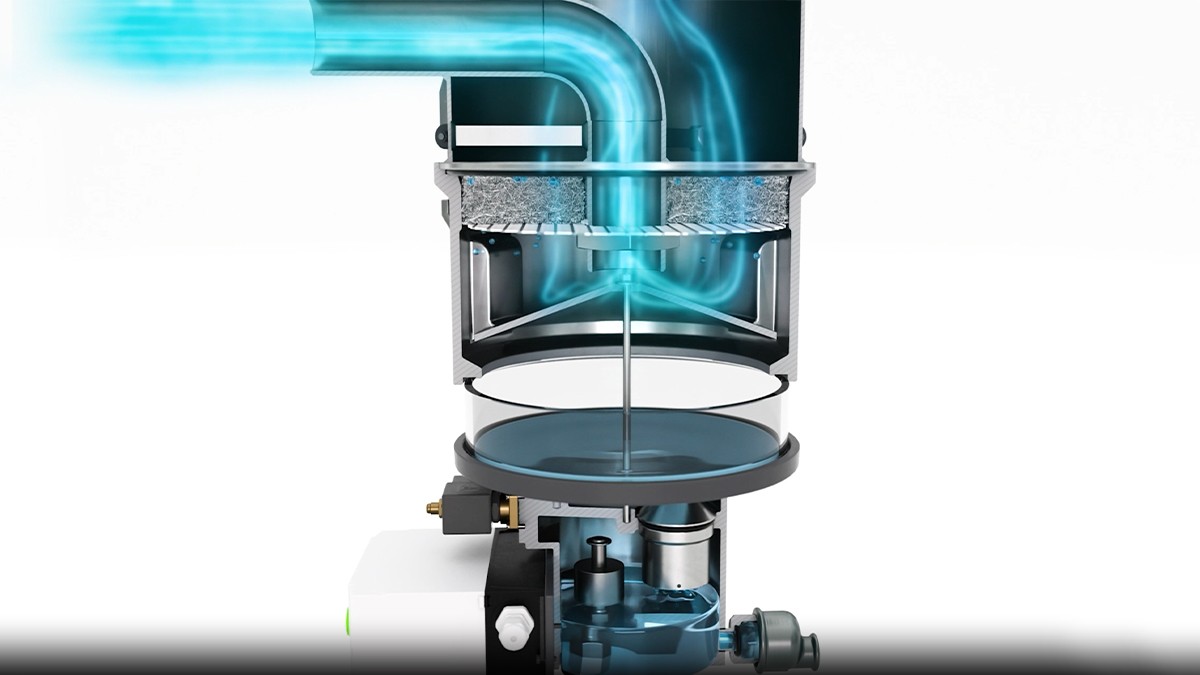
Cross-sectional view of a separator showing gas flow through internal filtration elements and liquid collection at the bottom, enabling cleaner gas flow to the vacuum pump. Source: Busch Group.

-
test
Cross-sectional view of a separator showing gas flow through internal filtration elements and liquid collection at the bottom, enabling cleaner gas flow to the vacuum pump. Source: Busch Group.
For applications with high liquid or particulate loads, cyclone separators provide additional performance. By spinning the gas into a rapid vortex, centrifugal force drives heavier contaminants to the chamber wall, where they settle out. The cleaned gas exits at the top, ready to enter the vacuum pump. Cyclone separation is particularly effective where contamination levels are unpredictable or extreme.
-
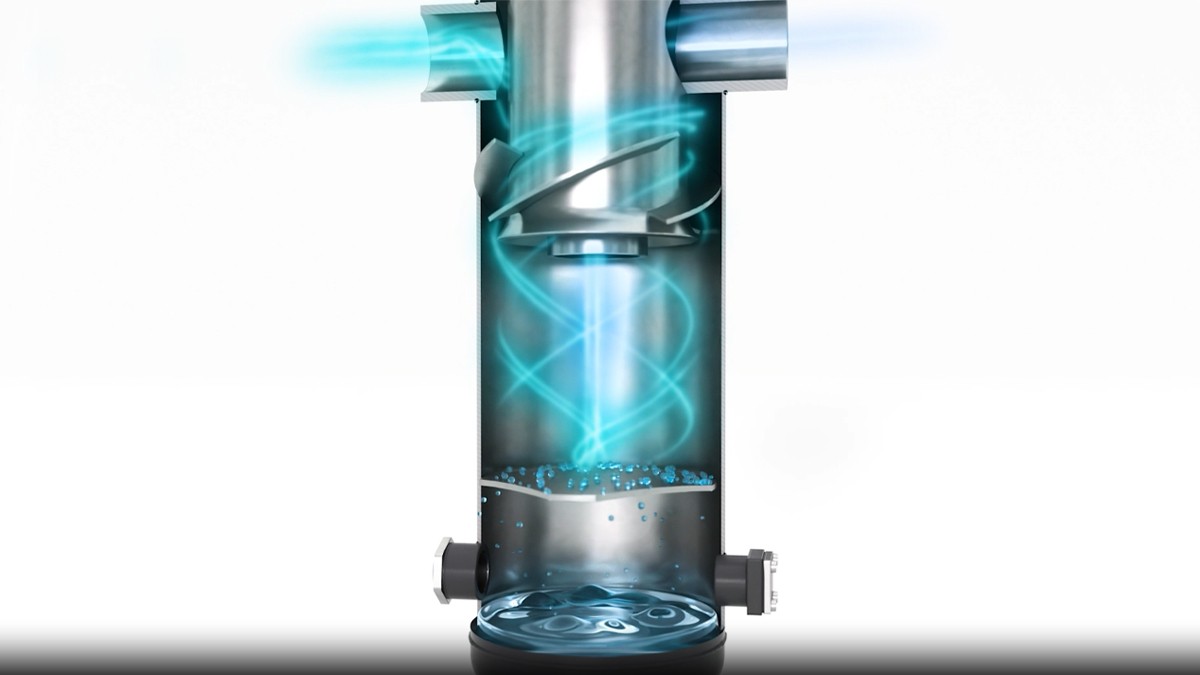
Cyclonic separator design with tangential inlet, illustrating rotational flow and separation of condensate from the gas stream, reducing contamination reaching downstream equipment. Source: Busch Group.

-
test
Cyclonic separator design with tangential inlet, illustrating rotational flow and separation of condensate from the gas stream, reducing contamination reaching downstream equipment. Source: Busch Group.
Condensers and heat exchangers: managing vapors before they reach the vacuum pump
While separators remove liquids already present in the gas stream, in vacuum processes liquids often evaporate as pressure decreases. Water, solvents, or process media can therefore enter the system in the gas phase and pass through separators without being removed.To address this, condensers or heat exchangers are installed upstream of the vacuum pump. By cooling the gas stream, vapors are brought below their condensation temperature at a controlled location to be removed before entering the pump.
This is particularly important because condensation can otherwise occur inside the vacuum pump. As the gas progresses towards the exhaust, temperature conditions within the pump can promote condensation. This can lead to contamination, deposits, or unstable operation.
Temperature control is an additional factor. Gas compression and process conditions can increase gas temperature. Each vacuum pump has a defined maximum inlet temperature, and exceeding this limit can affect clearances, lubricants, or internal components. Cooling the gas ensures that it enters the pump within the specified operating range.
Flushing: cleaning from the inside
Even with the best external protection, some contaminants will still reach internal vacuum pump components. In some cases, these residues can harden into deposits over time. This can restrict flow, cause corrosion and accelerate wear.Regular flushing prevents this. Using compatible fluid, operators can wash away residues and condensates, keeping the vacuum pump interior clean and protecting seals and lubricants. The frequency of flushing depends on process conditions. Vacuum pumps exposed to humid or heavily contaminating gases require more frequent attention.
Best practice is to always follow manufacturer guidance and use approved flushing agents. This ensures the procedure is effective without damaging internal components such as seals.
Balancing protection and efficiency
While filters and separators play a critical role in extending equipment life, they must not compromise vacuum pump efficiency. Undersized or clogged elements can create resistance, forcing the vacuum pump to consume more energy.It is therefore essential to select filters and separators with sufficient surface area for the expected flow and contaminant load. Monitoring their condition regularly and replacing or cleaning them before they become restrictive makes protection and efficiency work together rather than against one another.
Long-term benefits
Filtration, separation and flushing can be core to the performance and longevity of a vacuum system. When properly applied, they deliver:- Consistent process performance, with stable vacuum levels and predictable performance.
- Reduced unplanned downtime, thanks to fewer blockages or contamination-related failures.
- Lower maintenance costs, as vacuum pumps require fewer repairs and replacements.
- Extended equipment life, protecting your investment over the long term.
Most importantly, they help maintain vacuum pump efficiency, ensuring that energy use remains low and operating costs stay under control.
Summary
Protecting a vacuum system from contamination is one of the simplest and most effective ways to improve performance. Filters prevent harmful solids from entering the vacuum pump. Separators remove liquids and vapors before they cause damage. Flushing clears residues that build up over time.Together, these measures preserve efficiency, extend equipment lifetime and reduce operating costs. When carefully selected and maintained, they repay their investment many times over – not only by keeping your system running smoothly today, but by safeguarding reliability for the future.